ZEROPINK | PLATE Reverb
A steel sheet in a wooden box —
and the tail-control the original never had.
Before digital, the room you could not afford was a plate: a sheet of steel hung under tension, a driver at one end, pickups at the other. Hit it and the whole sheet rings — dense, smooth, without the flutter of a spring or the walls of a real room. It is the reverb on most of the vocals you grew up with, and the splash on most of the snares.
PLATE Reverb gives you that sheet in two voicings. VOCAL is the lush one — a slow, smooth build, dark, with a pre-delay floor that keeps the words in front. PERC is the splash — immediate, grainy, bright, gone. Two different plates, not one plate with a tone knob.
Then the part the hardware never had: a tail-control. The tail can DUCK out of the way while the source plays and swell back in the gaps, or GATE — hold flat, then cut hard, in time with the song. Digital precision on a classic sound.
Lead vocals that need space without losing the words. Snare and drum-bus splash that sits in the groove. Any reverb that has to stay out of the way of the thing it is on.
Rooms, halls, or early reflections. A plate has no walls — it is one sheet, everywhere at once.
Nothing to stage. The glass takes the whole band.
A plate’s tail is proportional to what you feed it — there is no threshold and no level-dependent character to stage for, and on a send the faders already set the level.
The tail-control’s detector is level-relative too: DUCK depth is measured against the dry signal’s own level, so the plate behaves identically hot or quiet.
Everything in the glass moves live as you turn the knobs — set the tail by eye, then confirm by ear.
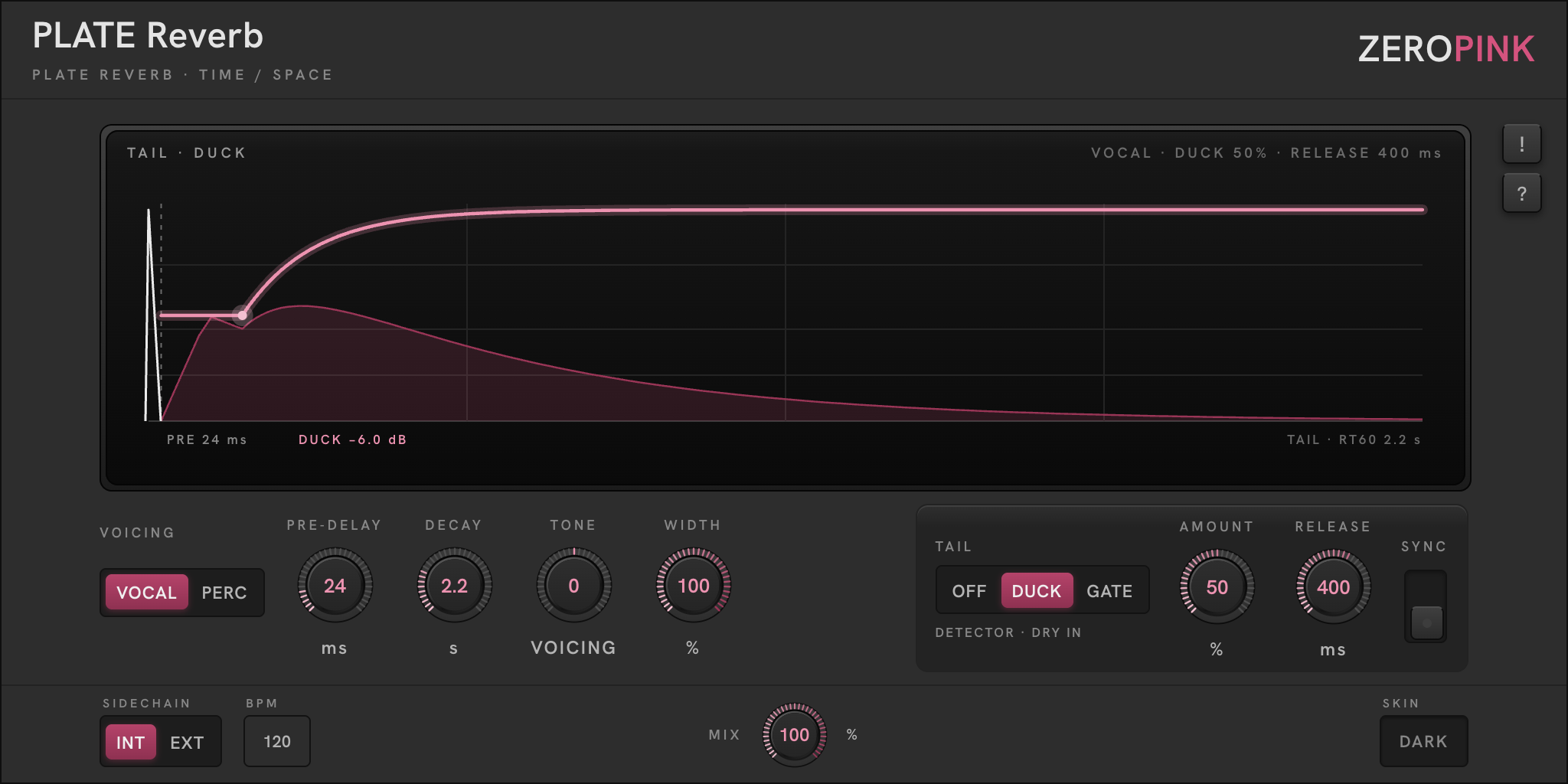
The tail, drawn.
Time runs left to right across the full width of the plugin. The white spike is the dry hit. The dotted line is the pre-delay gap — nothing rings until then. From there the shaded area is the tail, fading over the DECAY time; the baseline prints it as RT60.
The envelope
The bright pink trace is the tail-control envelope — what the tail is being told to do on top of its natural decay. With TAIL off it is a flat line at the top: the plate runs free.
Duck
The envelope starts low (by AMOUNT, printed in dB) and recovers at RELEASE. Read it as: this much quieter while the singer sings, back to full this fast when they stop.
Gate
The envelope holds flat for HOLD, then drops to nothing at RELEASE. The node marks the cut point; HOLD and CUT are labelled on the baseline.
Voicing, plate, tail.
The plate
VOICING — VOCAL or PERC; switching also resets the tail to that plate’s sensible default. PRE-DELAY — the gap before the tail, in ms; VOCAL will not go below 20, PERC goes to zero. DECAY — how long the sheet rings, 0.2 to 8 seconds.
Tone · Width · Mix
TONE is a Zero Detent knob: 0 is the voicing exactly as designed, and the centre lights when you land there. Negative darkens the tail, positive brightens it. WIDTH — the two-pickup stereo image; 100 is the full plate, 0 is mono. MIX — wet against dry; 100 on a send bus.
The tail well
TAIL — OFF, DUCK or GATE; the well shows the knobs that mode uses. SYNC — HOLD and RELEASE read in note values at host tempo, 1/32 to 1/2, dotted included. SIDECHAIN — INT runs the tail-control from the plugin’s own input; EXT takes an external sidechain: duck the snare plate from the kick.
Three ways in.
VOCAL, on a send at MIX 100. PRE-DELAY 40–80 ms so the words land dry. TAIL on DUCK, AMOUNT 50, RELEASE around 400 ms — the tail blooms between phrases and steps aside under them.
PERC, PRE-DELAY 0. TAIL on GATE with SYNC on: HOLD ⅛, RELEASE 1/16. Every hit gets a splash exactly one eighth long that cuts before the next one. Push DECAY for a bigger sheet; the gate still ends it.
Plate on the snare, SIDECHAIN to EXT, feed the kick. TAIL on DUCK — the snare’s tail steps aside for every kick and keeps the low end clean without touching the snare itself.
Thirty days, nothing held back.
Every install starts a 30-day full trial — the remaining time shows in the nameplate, no account needed. To buy: the checkout opens in your browser and your license key arrives by email.
To activate: paste the key into ACTIVATE. Once licensed the trial readout disappears and the wordmark opens your license details; unlicensed, it opens zeropink.net. The ! cap latches hover tooltips; the ? cap opens the manual.
Lost your licence? Retrieve it from My Account — enter the address you purchased with and it is sent again.