ZEROPINK | DELAY
Four generations of echo —
and a map of every repeat.
Every era had its delay. The tape loop with its wow and its warmth. The bucket-brigade pedal, dark and grainy. The first digital racks, clean and exact. And the lo-fi boxes that made a virtue of falling apart. Each one is a different way of repeating a sound, and each one has a place in the mix.
DELAY gives you all four as VOICING — DIGITAL, TAPE, BBD, LO-FI — with one AGE knob that brings in the wow, flutter and saturation of the older circuits. Underneath sits a stereo delay line that runs MONO, STEREO or PING PONG, with independent left and right times in note values or milliseconds.
The digital precision is in the tail: a feedback loop you can cross-feed and filter, a modulation stage (CHORUS, FLANGE, PHASE) inside the loop, a DUCK that pulls the repeats under the source, and a FREEZE that holds the loop for as long as you like.
Vocal throws that stay out of the words. Dotted-eighth guitar lines. Ping-pong width on keys and pads. Dub tails — feedback high, filters closing, freeze held.
PLATE Reverb — delay for the rhythm, plate for the space. Both carry the same DUCK, so the source stays in front of both.
The tap map.
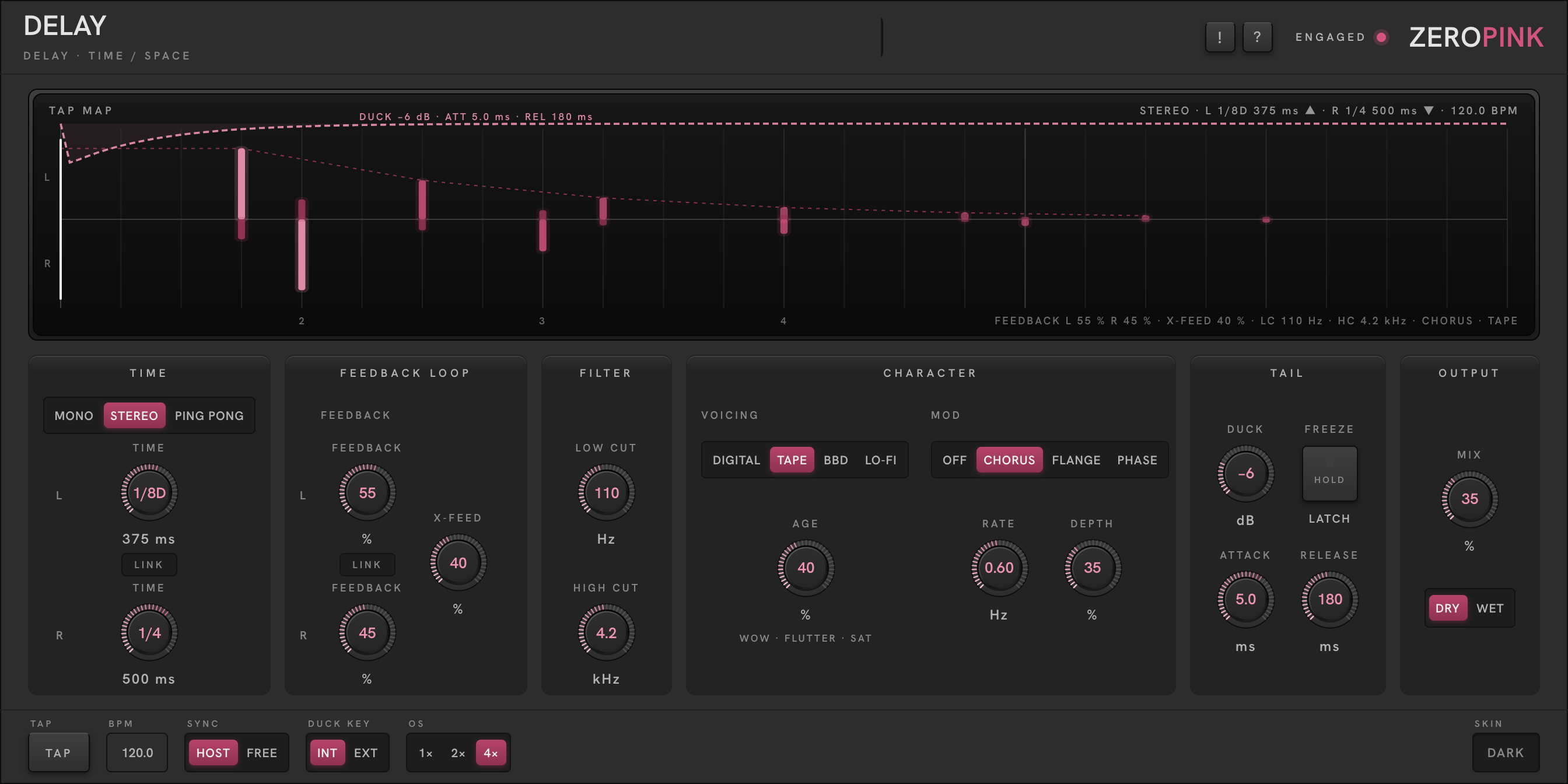
Time runs left to right in beats, the white line is the dry hit, and every repeat is drawn where it will land — left taps above the centre line, right taps below, each one shorter as the feedback decays. The header prints the mode, both times and the tempo; the baseline prints the loop: feedback per side, X-FEED, the filter corners, the modulation and the voicing.
The taps
Change a time and the taps move; raise feedback and the row runs longer. In PING PONG the taps alternate sides — you see the bounce before you hear it.
The duck curve
The dotted trace over the taps is the DUCK envelope, labelled in dB and release time: how far the repeats drop while the source plays and how fast they come back.
The readouts
Every knob prints its value in the monospaced Readout — 1/8D and 375 ms at once, so the note value and the time are never a mental conversion away.
Time, loop, filter, character, tail, output.
Time
MONO / STEREO / PING PONG sets how the two lines relate. TIME L and TIME R each take a note value at host tempo (dotted and triplet included) or free milliseconds; LINK ties them. The footer TAP button and BPM field set the free tempo; SYNC follows the HOST or runs FREE.
Feedback loop
FEEDBACK L / R — how much of each repeat returns, per side, with a LINK between them. X-FEED sends a share of each side into the other: 0 keeps the channels apart, up towards 100 they blur into one wide tail. LOW CUT and HIGH CUT sit inside the loop, so every pass gets narrower — the way tape and bucket-brigade repeats always did.
Character
VOICING — DIGITAL, TAPE, BBD or LO-FI. AGE brings in that circuit’s wow, flutter and saturation, from pristine to worn. MOD places a CHORUS, FLANGE or PHASE in the feedback path, with its own RATE and DEPTH; each pass through the loop modulates again.
Tail · Output
DUCK — in dB, how far the repeats drop under the source; the footer DUCK KEY picks the plugin’s own input (INT) or an external sidechain (EXT). FREEZE holds the loop — HOLD while pressed, or LATCH. MIX — wet against dry; DRY THRU / KILL passes or removes the dry path for a send bus. OS — 1×, 2× or 4× oversampling for the voicing and saturation stages.
Three ways in.
STEREO, TAPE voicing, TIME 1/4 both sides, FEEDBACK around 30. DUCK −6 dB, key INT — the repeats sit under the line and bloom in the gaps. On a send with DRY on KILL.
PING PONG, DIGITAL voicing, TIME L 1/8D and R 1/8D, FEEDBACK 40, X-FEED low. Clean, exact, alternating sides. Raise AGE a touch to take the edge off.
MONO, BBD voicing, AGE high. FEEDBACK 70 or more, LOW CUT and HIGH CUT closing in, MOD on CHORUS at a slow RATE. Hit FREEZE on LATCH to hold the loop and ride the filters by hand.
Thirty days, nothing held back.
Every install starts a 30-day full trial — the remaining time shows in the nameplate, no account needed. To buy: the checkout opens in your browser and your license key arrives by email.
To activate: paste the key into ACTIVATE. Once licensed the trial readout disappears and the wordmark opens your license details; unlicensed, it opens zeropink.net. The ! cap latches hover tooltips; the ? cap opens the manual.
Lost your licence? Retrieve it from My Account — enter the address you purchased with and it is sent again.